Indypex 2025 Recap: In Which I Encounter a Tome of Monumental Weight and Proportion
Friday morning at 6:30 in the AFM I jumped in my car and set off for INDYPEX, this being the second year at the new location, now located to the west of Indianapolis proper rather than east. Great for me, as it shaves off just about a half hour from the drive each way. It still ended up being about 2 hours, no thanks to the [HEAVILY CENSORED] road construction on the Peoples Republic of Illinois side of the border. *grumble*
I got to the facility at 9:30AM, a half hour before the show opened. I was the first person there waiting to get in. About 10 minutes after I got there, a few other collectors arrived, an older group who appeared to be in their late 70s, including a gentleman walking with a cane. It is here that I have to mention my one complaint about the show… one that is IMO inexcusable for a WSOP show.
There was no place for people waiting to enter the show to sit down. I didn’t personally mind, as I’m a (comparatively) spry youngster verging on entering my 60s, but for these other folks, it was clearly an issue. There were some tables and chairs immediately *inside* the entrance to the show, so they sat down there to wait to sign in. One of the two people manning the entrance table snarled “We’re not open yet!” and we explained that no one was trying to get into the show early, but the people waiting needed to be able to sit down. This club member, whom I will not name, had the most dour disposition I’ve ever seen from someone greeting people at any show, even tiny club shows… let alone a major WSOP event. Every time I saw him for the remainder of the day (had it not been for this incident, I would never have paid attention, but now that he was on my radar…), he had a frown on his face and was complaining about something or someone. Definitely NOT a person who should be the face of a show.
To whomever needs to know: If it is so critical that evil and nefarious stamp collector heathens be thwarted from crossing the mystical doorway until the the sacred bell tolls the magical hour of 10AM, then maybe PUT SOME [CENSORED] CHAIRS OUT IN THE HALLWAY WHERE PEOPLE WILL WAIT!
*harumph!*
Ok, now that’s off my chest… I feel much better now. 
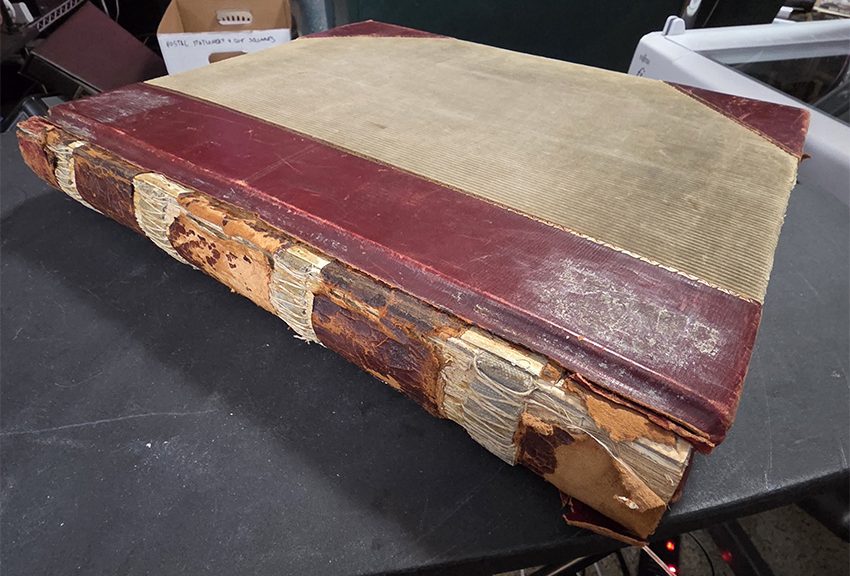
As with every show, my first stop was with Denny Peoples. I had just been to his house about a week and a half ago and gone through his inventory then, so this was primarily to see if he had bought anything during show setup that would be up my alley. He showed me a ginormous ledger book with revenues affixed to transactions, but it was entirely 20th century and the price was high, so I didnt give it much attention. This is called foreshadowing… we’ll be back to this item eventually. 
My next stop was with Brad Houser of Village Stamp & Coin. He had some wonderful U.S. revenue collections, but way beyond my budget ($12K for $49K in catalogue value might be a great deal, but just not viable for me). He had some lots of printing anomalies, preprint paper folds, freak perfs, etc., but nothing I couldn’t live without… sort of. Yup… more foreshadowing!
While at Brad’s table, the gregarious Wayne Gehret walked by and I asked if he had anything for me. He said he did, so that was my next stop. He had several binder books of U.S. revenues, so I spent some time going through them. Some decent material, but the only thing I picked out was an unattributed foreign entry on Scott #R116, a position I don’t believe I already have. He also had a huge carton of U.S. and world revenue documents (mostly the latter), that he wanted a king’s ransom for, but he let me go through it. I found a manilla folder stuffed with hundreds of 1st issue revenue documents, mostly small format, but a few caught my eye immediately, being dated October and November of 1862. His quoted price made me blanch. I said I appreciated the offer, but I couldn’t justify that. He then said “Well, what do you want to pay?” Ahh, music to my ears! I said I didn’t want to insult him, to which he replied “Too late for that!”… Wayne’s got a great sense of humor, and there are always little barbs and jabs going back and forth. I stated a price that was fully 40% below what he quoted me. While he didn’t accept it, he came back with a number just marginally higher than my counter, so it was all good. The group I purchased included an ornate letterhead-cover combo from the Odd Fellows Association, circa 1878.
I stopped by to see Scott Couch, owner of Tiger Collectibles, and Karl Groth with Michigan Street Antiques. I had seen both at our local MSDA show in August, and neither had anything new for me to acquire. I stopped by to pay my regards to Rusty Shoaf, who was on the mend from some recent medical issues. He hopes to be fully baack up to speed when I see him next at CHICAGOPEX in November.
I then stopped by to see Eric Scott with The Stamp Shop. He too was on the mend, having recently had a hip replacement and then subsequently Covid. Oy vey! He had brought a revenue “junk lot” along for me, which we sparred back and forth about. He then trotted out a number of sales binders of new revenue material, which actually had some lovely material. I picked up several cancel items, an R45d silk paper, and a mint OG pair of R29d (5c Proprietary, silk paper), both silks being no-questions-about it items with respect to paper characteristics as well as the blue silk threads. The mint R29d pair was nice as the stamps exhibited threads both on the face of the stamps as well as the reverse. I also purchased a pair of R101a ($50 green) exhibiting the latest dated cancel I have seen on an imperf, April 1870… presumably a west coast use. Lastly, a purchase just because the price was right: possibly the nicest example of RB8a (50 cent Proprietary) I have seen in years. No faults, no stains or heavy cancel, and bright color. Its only detraction is a partial row of “freak perfs” that runs partially through the stamp.
While I was sitting at Eric’s table, one of my collector friends from Rockford came by; he had brought some billheads for my collection. Another collector, whom I had arranged to meet at the show to hand off an R87a I was selling him, also came by, so we all chatted for a bit, talked about revenues and meeting up at CHICAGOPEX.
A new dealer I had not seen before, Stamps & Coffee, while not having any big-ticket revenue items, had a number of revenue cancels that found a home with me. Itty Bitty Stamp Co. had an Odd Fellows Hall of Sacramento stock certificate that I was able to procure inexpensively. Murphy’s Stamps had a Civil War-era revenue illegal use cover, that whilst a bit ratty, was reasonable in cost, so it came home with me.
I stopped back by Denny’s table, and he was in poor humor, not only because he couldn’t find an illegal use cover that he had set aside for me prior to the show, but also none of the dealers who had expressed ineterest in the aforementioned ledger had bought it. He offered it to me at a lower price than the first time. I said I would swing back around and look at it again once I had hit all the remaning dealers I wanted to see.
Russell Eggert of Dutch Country Auctions had brought along a stack of Ottmar Zeiher stamp postcards. I went through and picked out about 15 with designs or from makers that I didn’t already have. From Collector’s Exchange, I picked out a lovely item, another revenue that is listed but not valued in Scott: a mint block of 4 of Scott #R257, the $1 perforated 10. Mint never hinged to boot!
I spent some time at Wayne Youngblood’s table. He had brought along several illegal use covers from his collection that he was willing to part with. I traded him one of the stamps I had brought with me, so that eased the financial pain somewhat. From Hugh M. Clark I purchased an oddity, an R88a ($5 Conveyance imperf) that had been privately perforated using something akin to tiny pinking shears, i.e., a uniform zig zag cut. The overall margins, stamp color, and cancel date tell me this was a true imperf and not a perforated stamp that someone had tried to enhance. Moreover, R88a is a relatively high cat stamp ($350 in 2025 Scott), so without other telltale faults, it wouldn’t make sense for a collector to try to manufacture something like this.
I swung back around to Brad Houser’s table, to see if an item I had looked at earlier was still there. It was, and we came to agreement, so I acquired my second matched set of R85e, the $2 Probate of Will bisect, two halves of the same stamp on matching documents.
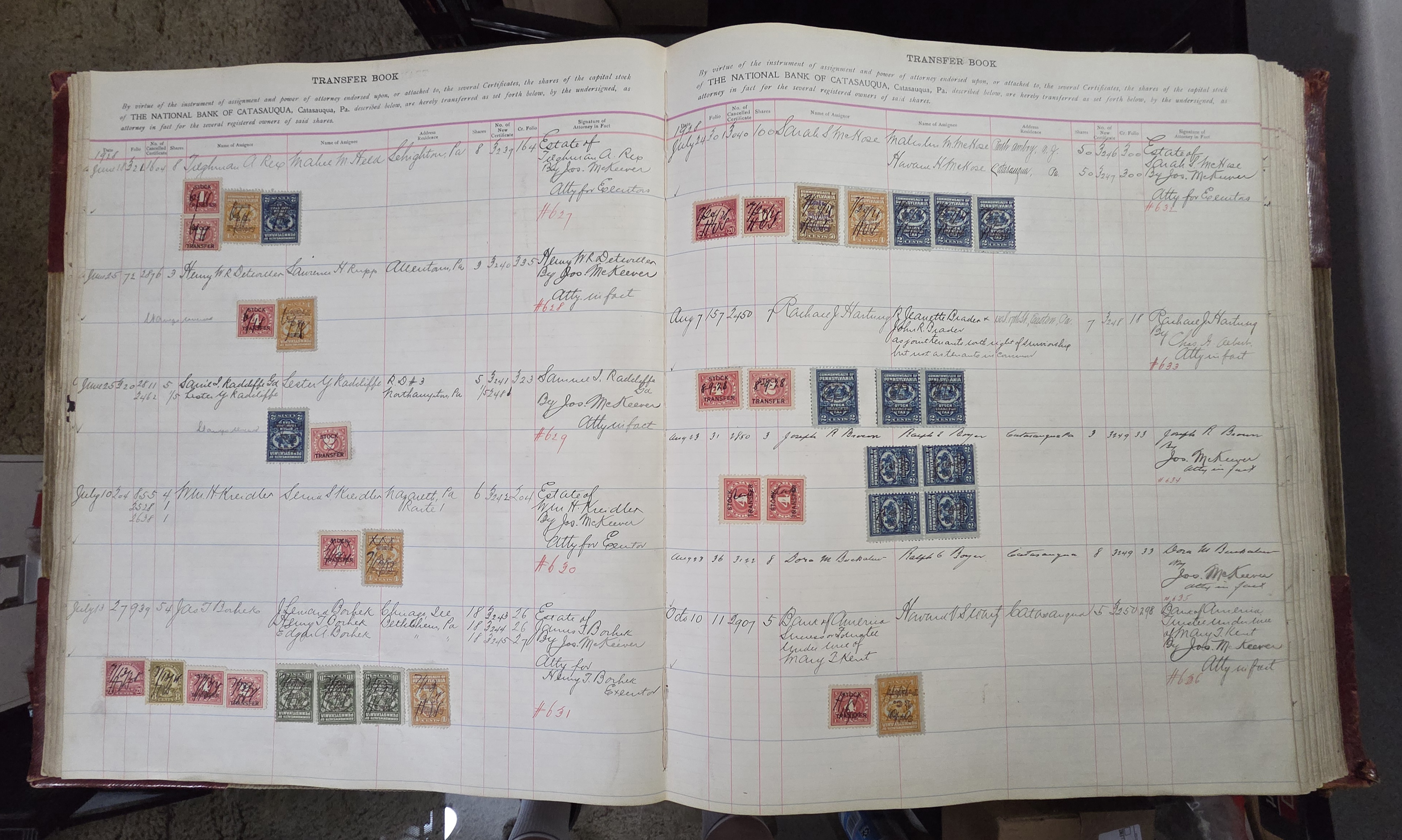
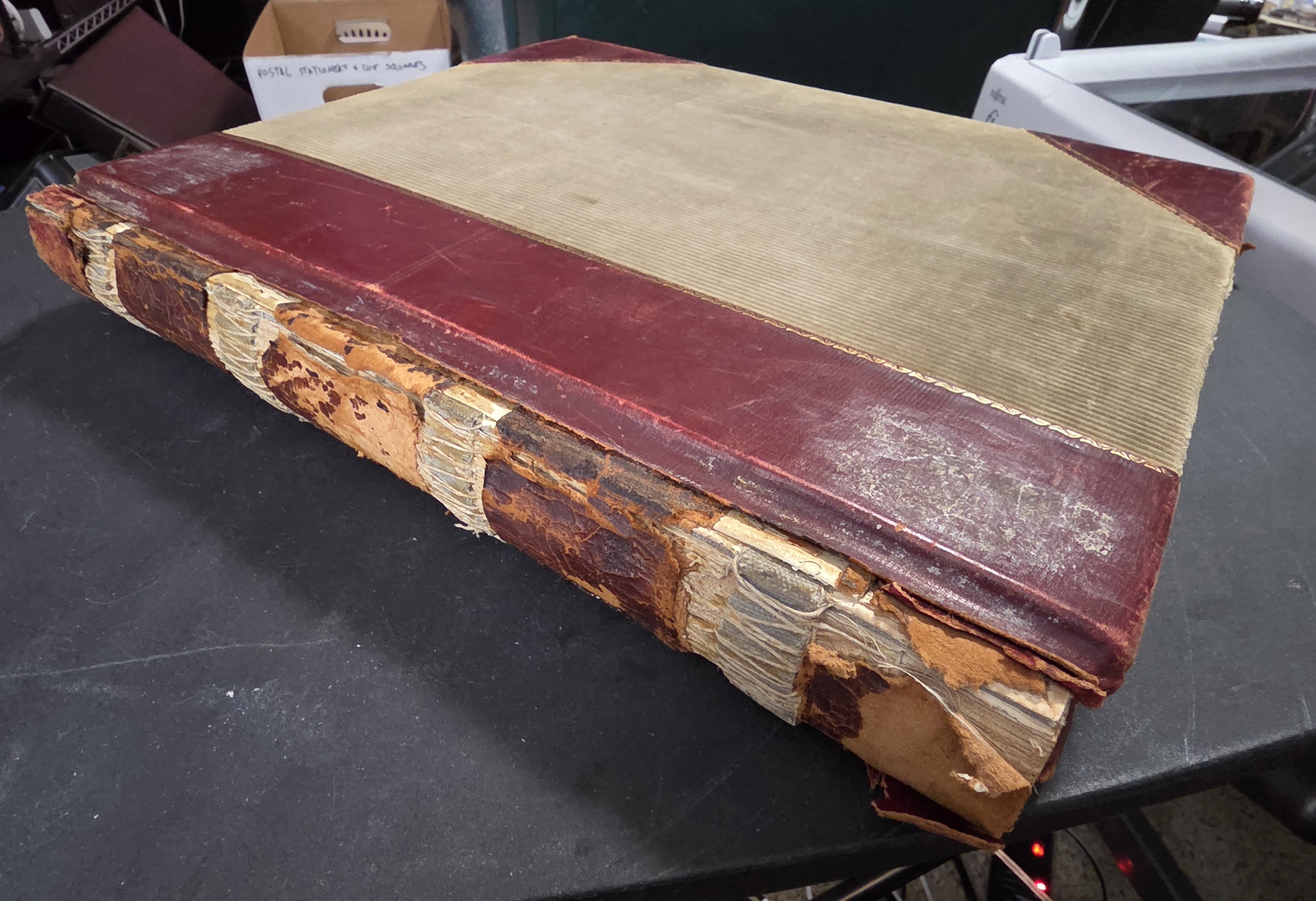
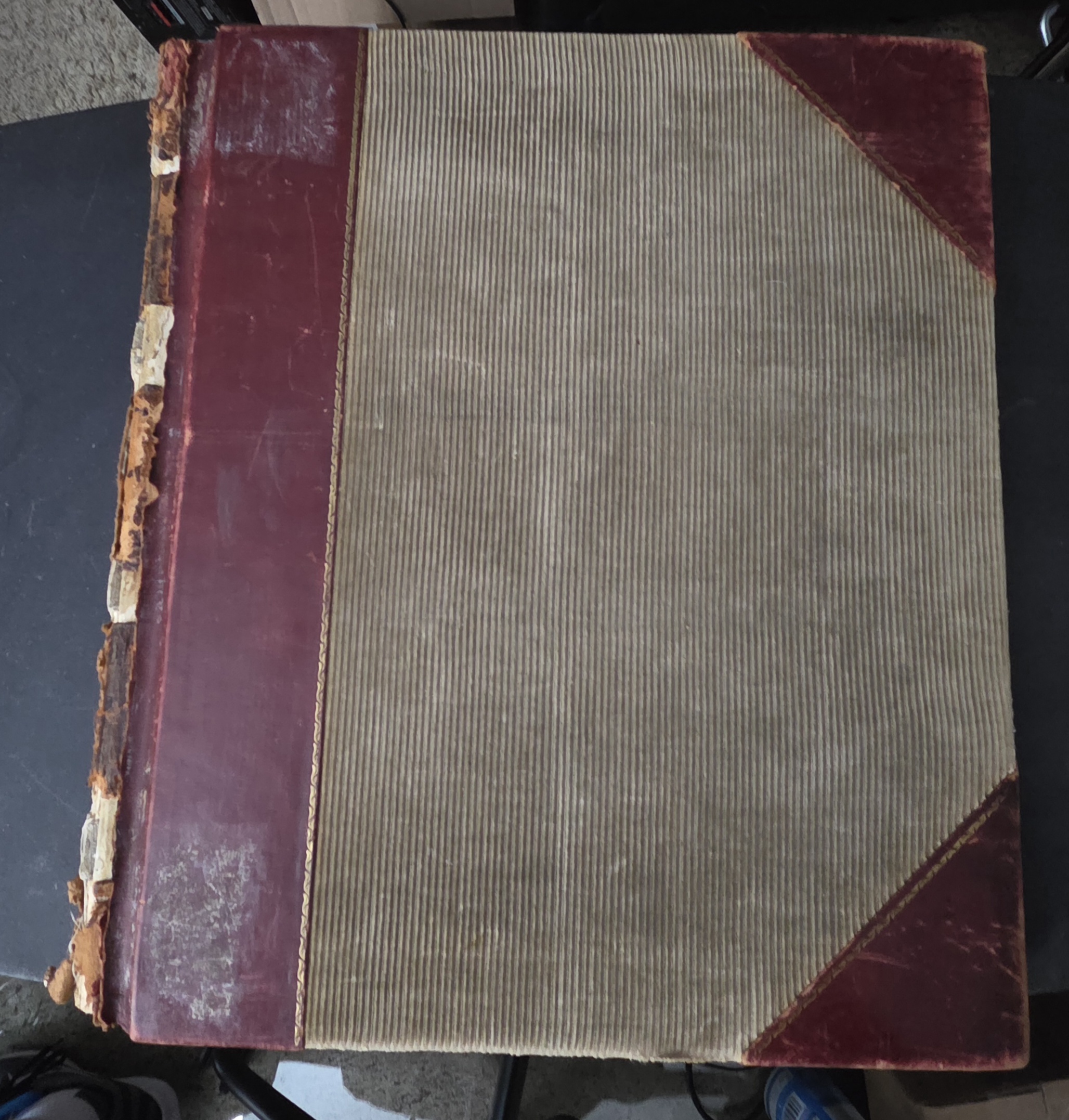
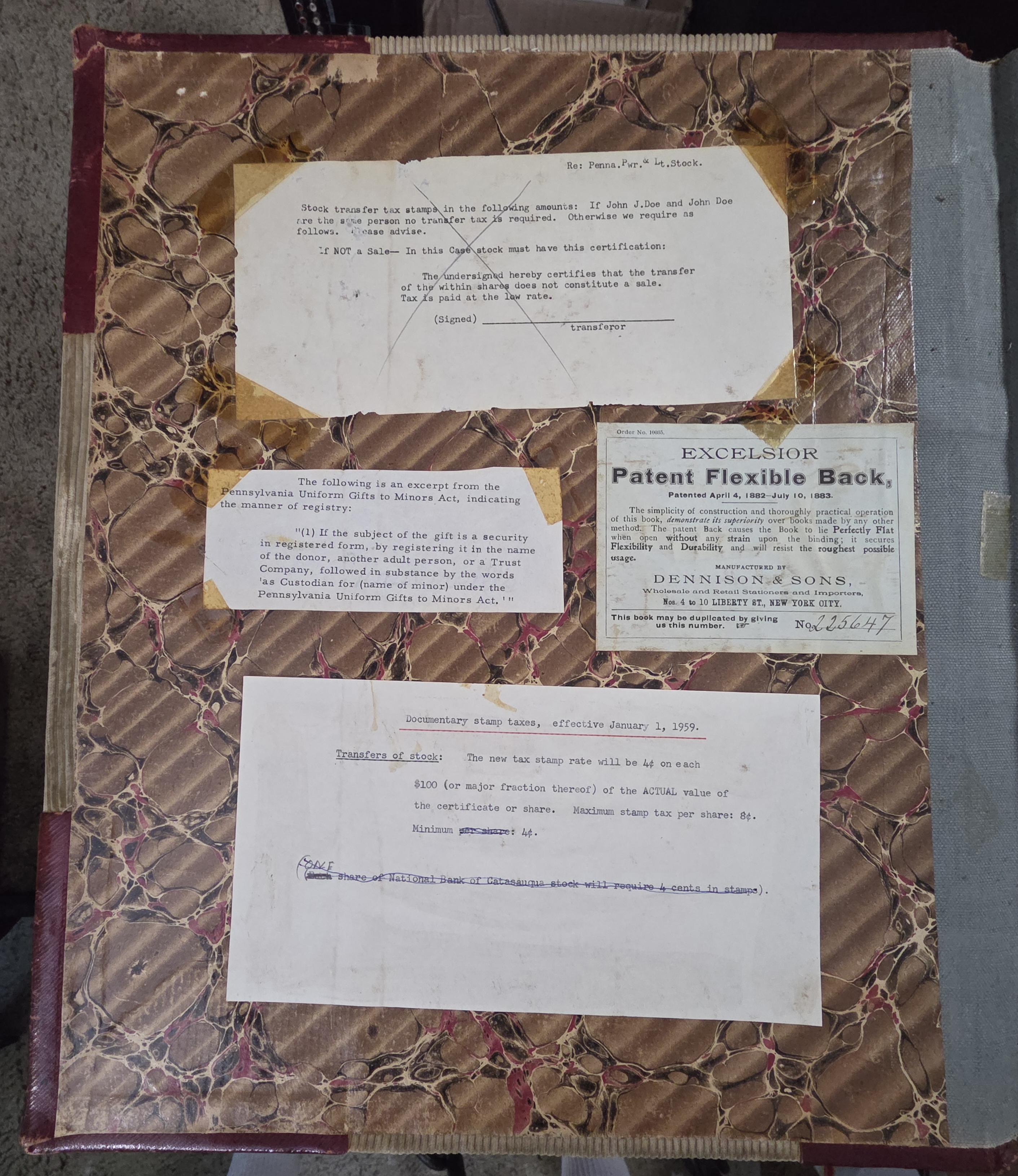
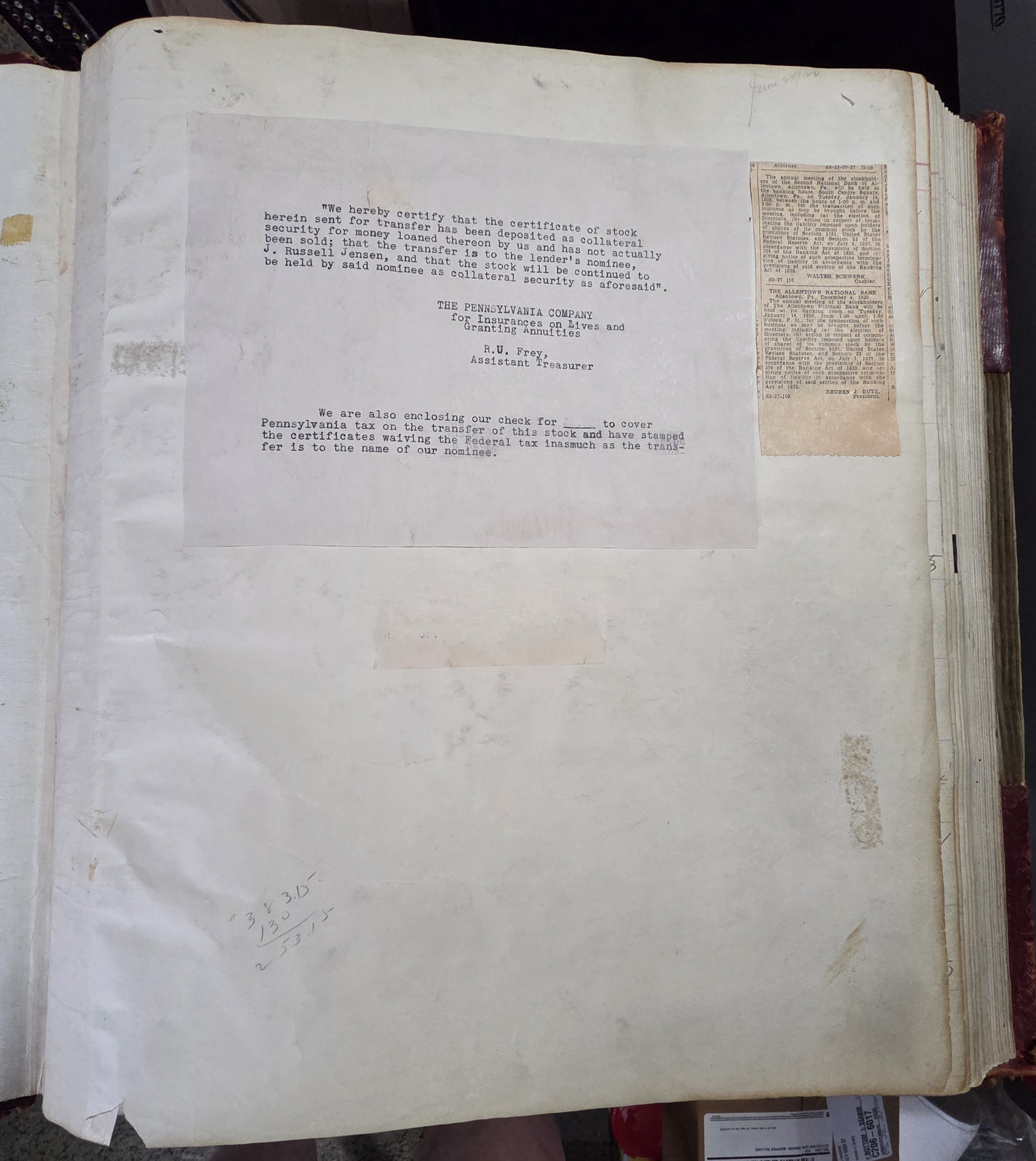
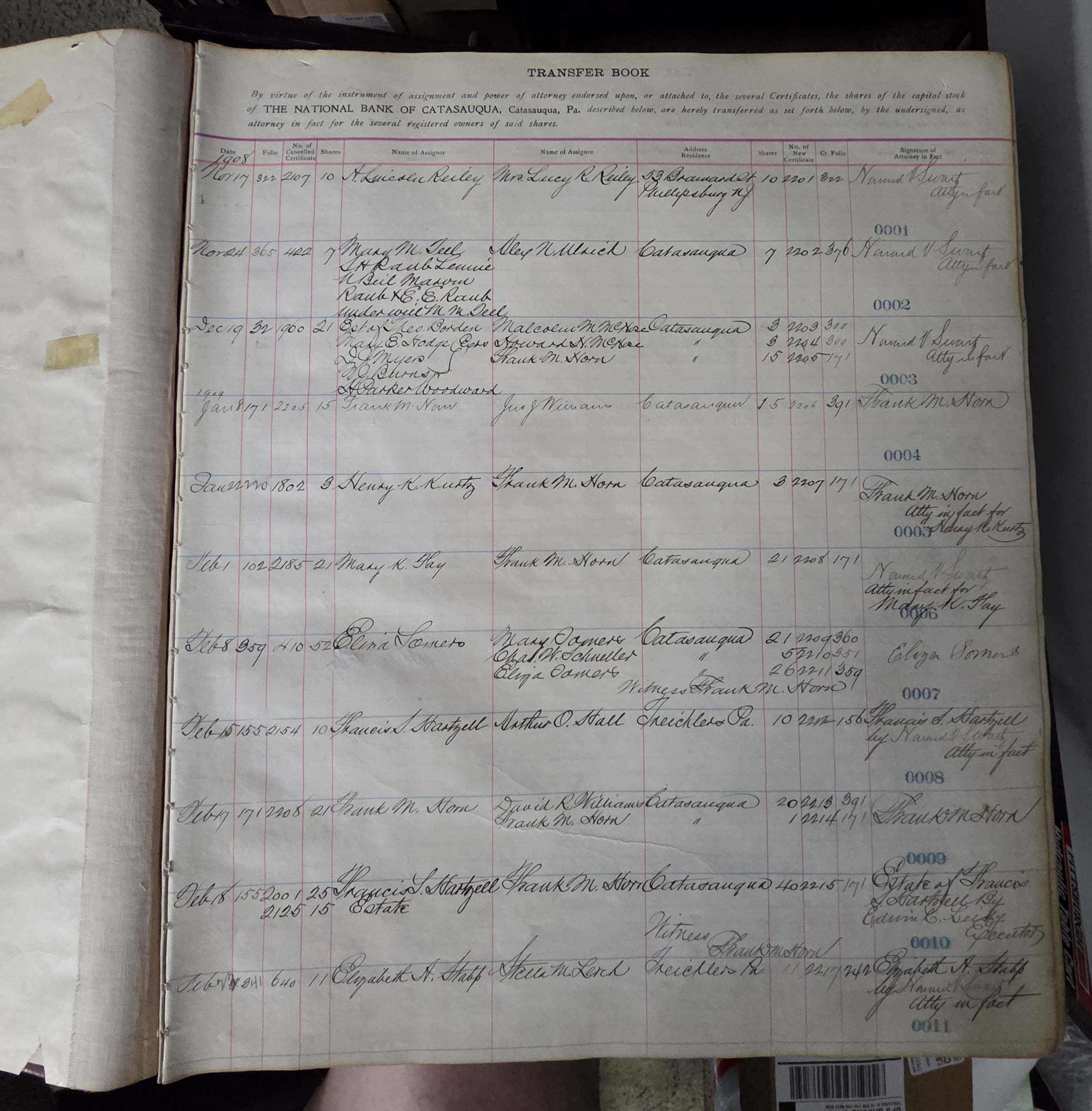
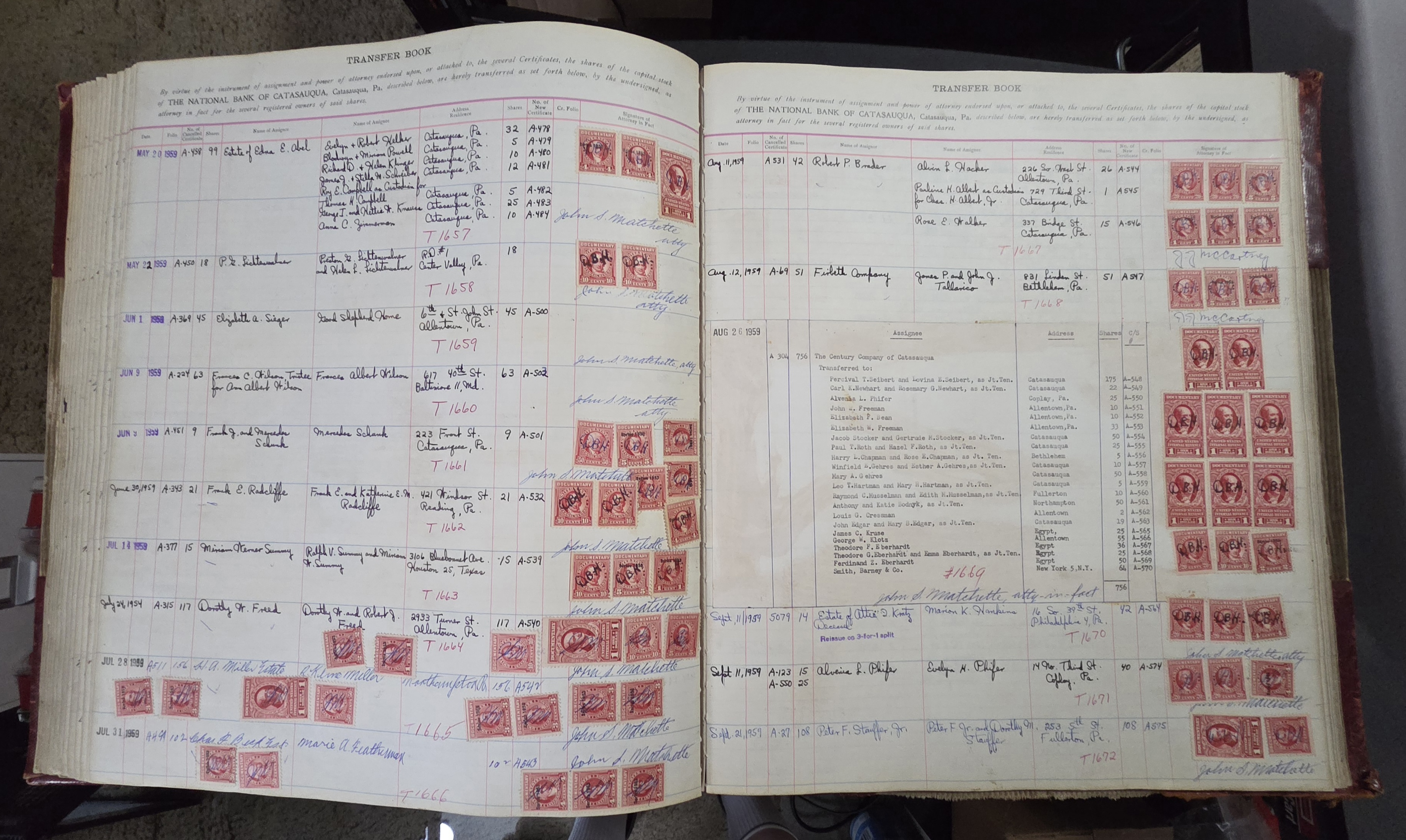
At this point it was getting late in the day, so I headed home to Denny’s table, to sit down and actually look through the ginormous ledger he was trying to sell. He had lowered the price again… The thing was huge and heavy, roughly 15 x 17 inches, and weighed about 13 pounds. It contained stock issuances and transfers from the National Bank of Catesaqua, PA from 1908 (pre-tax) all the way to 1960. As I was paging through it, I was thinking “what would I do with this?” as it is really nondisplayable and cumbersome in its current form. As much as historians might hate this prospect, I think the only way forward, both for display and to recoup costs, would be to break it down and deal with individual pages. I think the issue of how to deal with the form and logistics of this item may have contributed to why no one had bitten on it.
Speaking strictly from a mercenary perspective, I think these oversized pages with federal and PA state revnues affixed on both sides would sell relatively easily on eBay for $15-25 per sheet, so I approached it with this mindset, and did some maths. I got roughly one third of the way through the book, spotted something that apparently nobody else had (including Denny), and paid him.
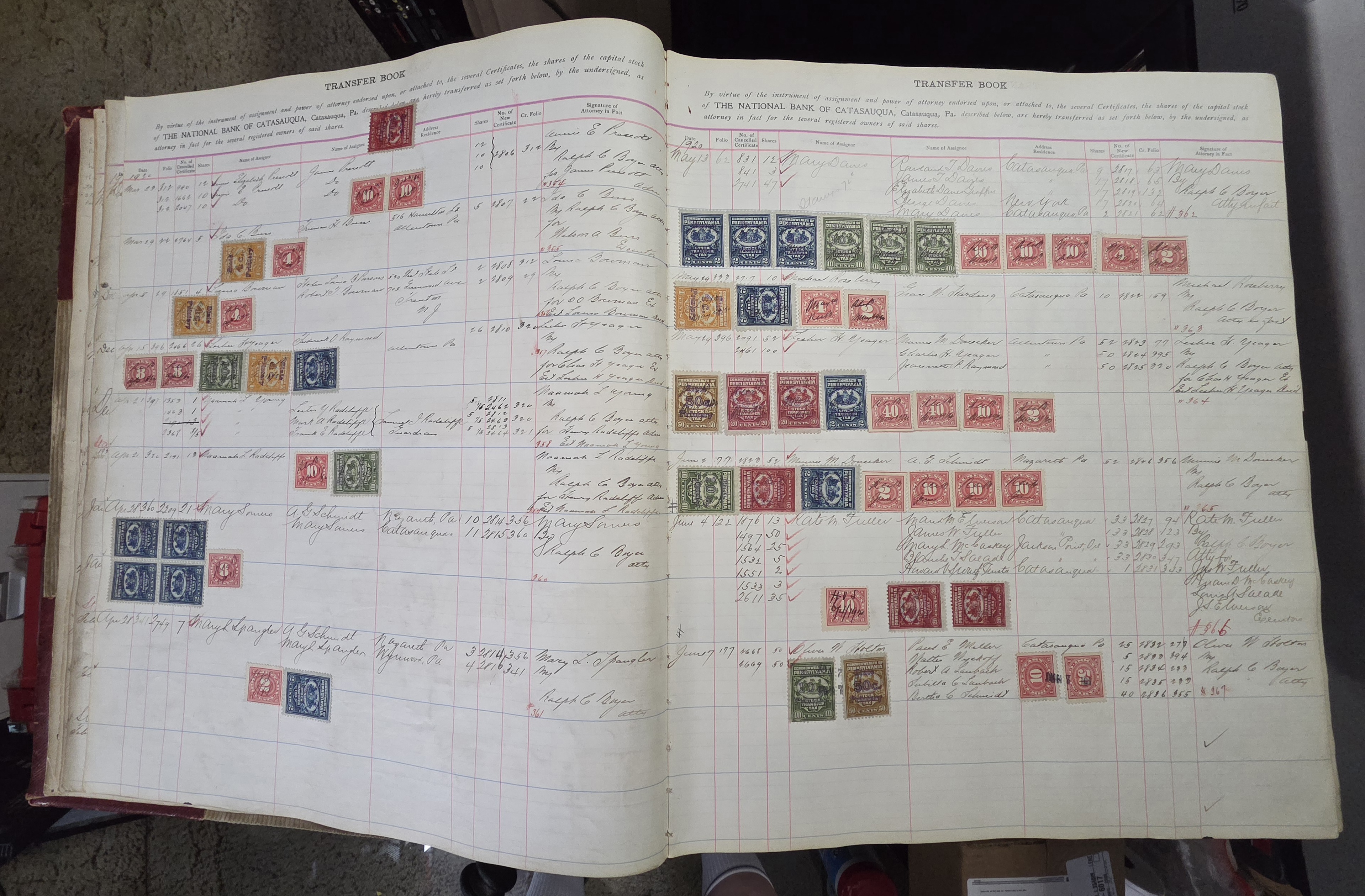
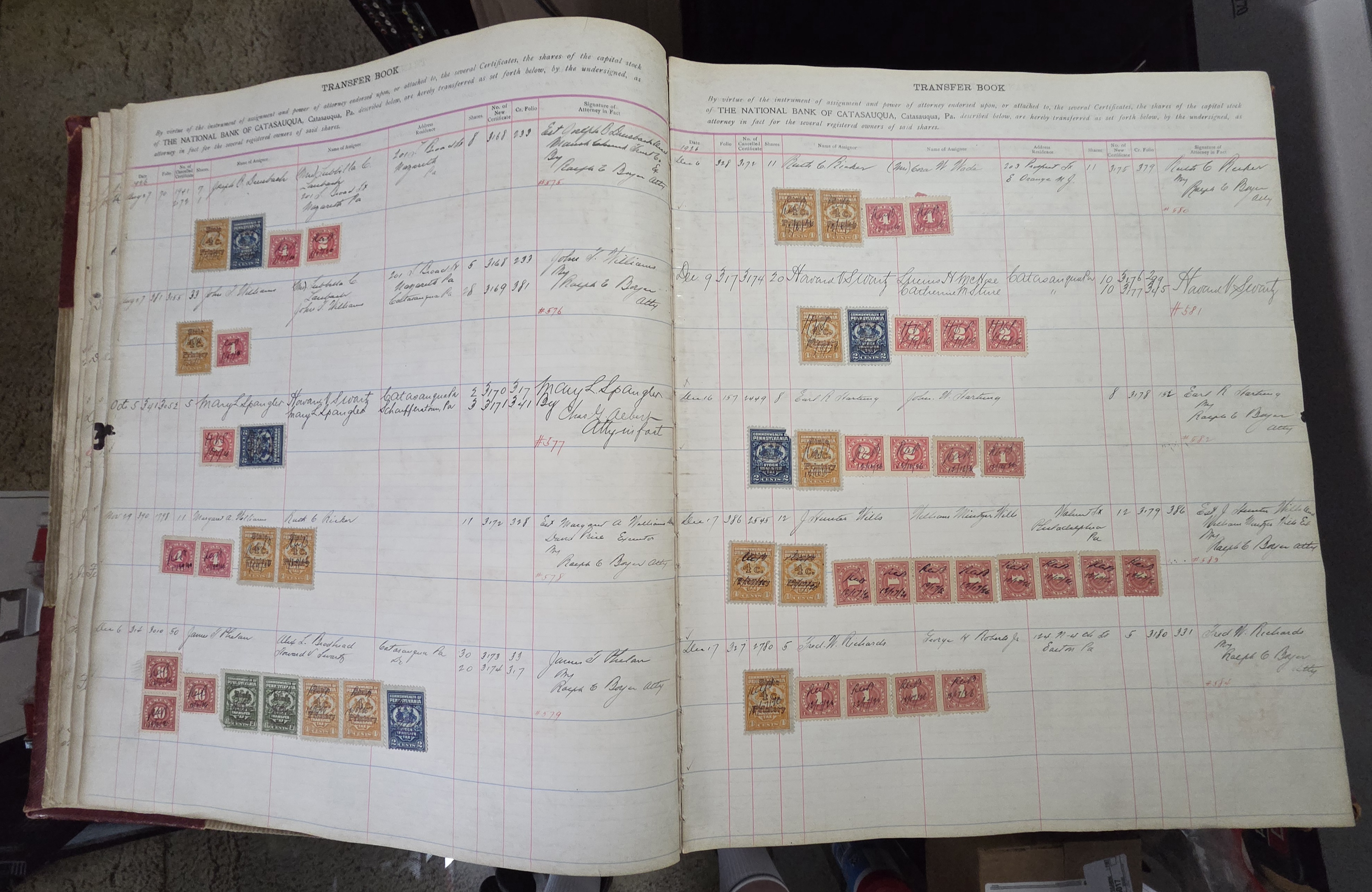
You get to see the entries and usage of revenue documentary and stock transfer stamps over time starting with federal documentaries in 1914, the addition of PA documentaries in 1916, through the various series of documentaries and stock transfer, then into reds and greens, etc. There are transaction line items containing both documentary and stock transfer revenues, and I don’t know whether this was simply out of expediency or if there was significance in the amounts for each.
No rarities or high-cat stamps on the federal side, although there may be some varieties and/or double impressions when it comes to the STOCK TRANSFER overprints. None of the 1952 greens, unfortunately. Just LOTS of federal and PA revenues affixed, but no serial numbered high denominations. Regardless, it’s an interesting study over time of stamp series/type/color.
Here are some representative cellphone pictures, followed by the reveal of the pages that I personally will keep (at minimum) for my collection. When I break it down, before I disperse any pages, I will photograph the entire thing (pages are too large to fit even on my 12×18 scanner, so DSLR and copy stand it is) so there is a historical record.
The keeper pages (thus far):
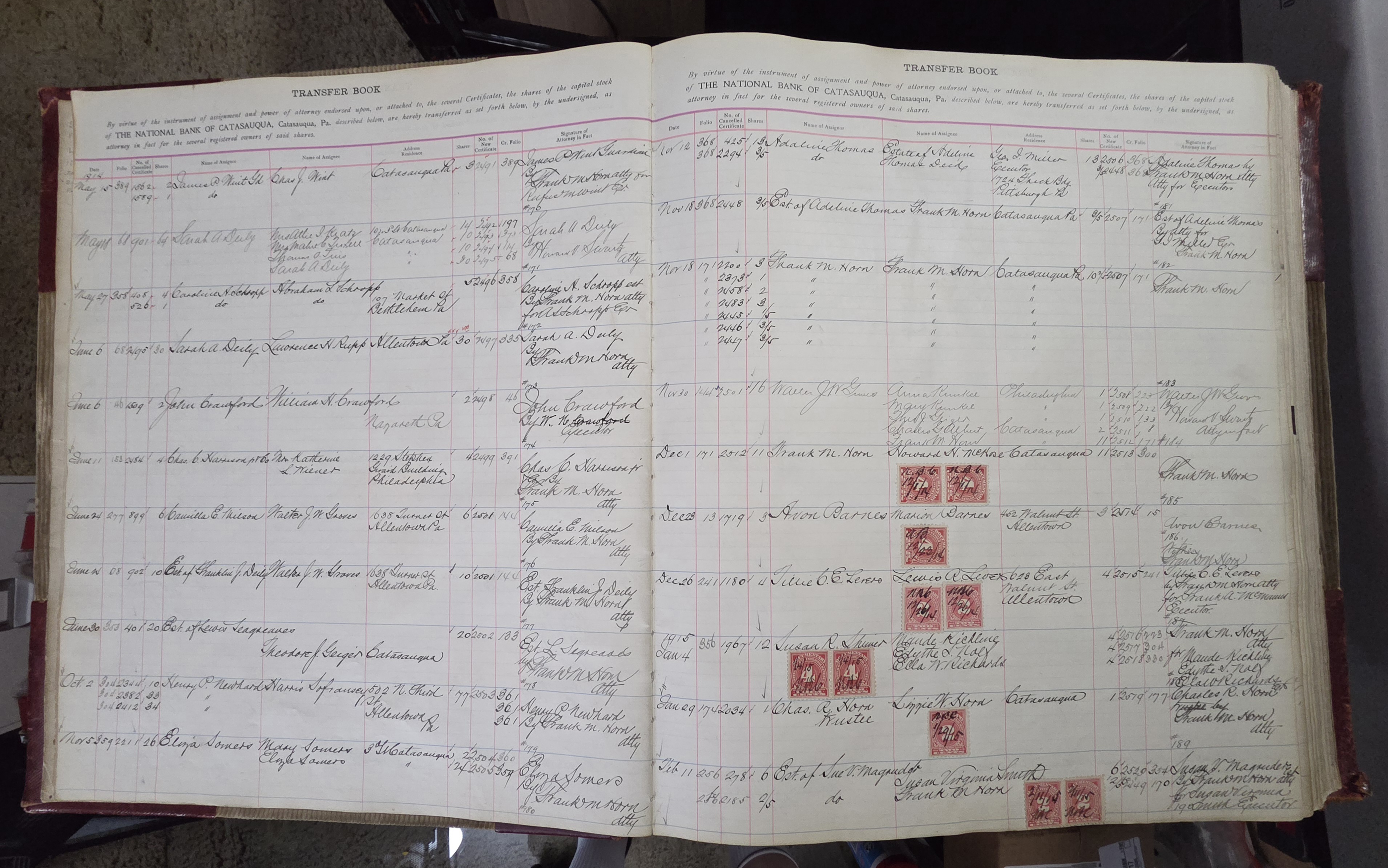
This page shows the advent of the documentary tax, including an entry dated and stamps canceled the first day of the tax, December 1, 1914.
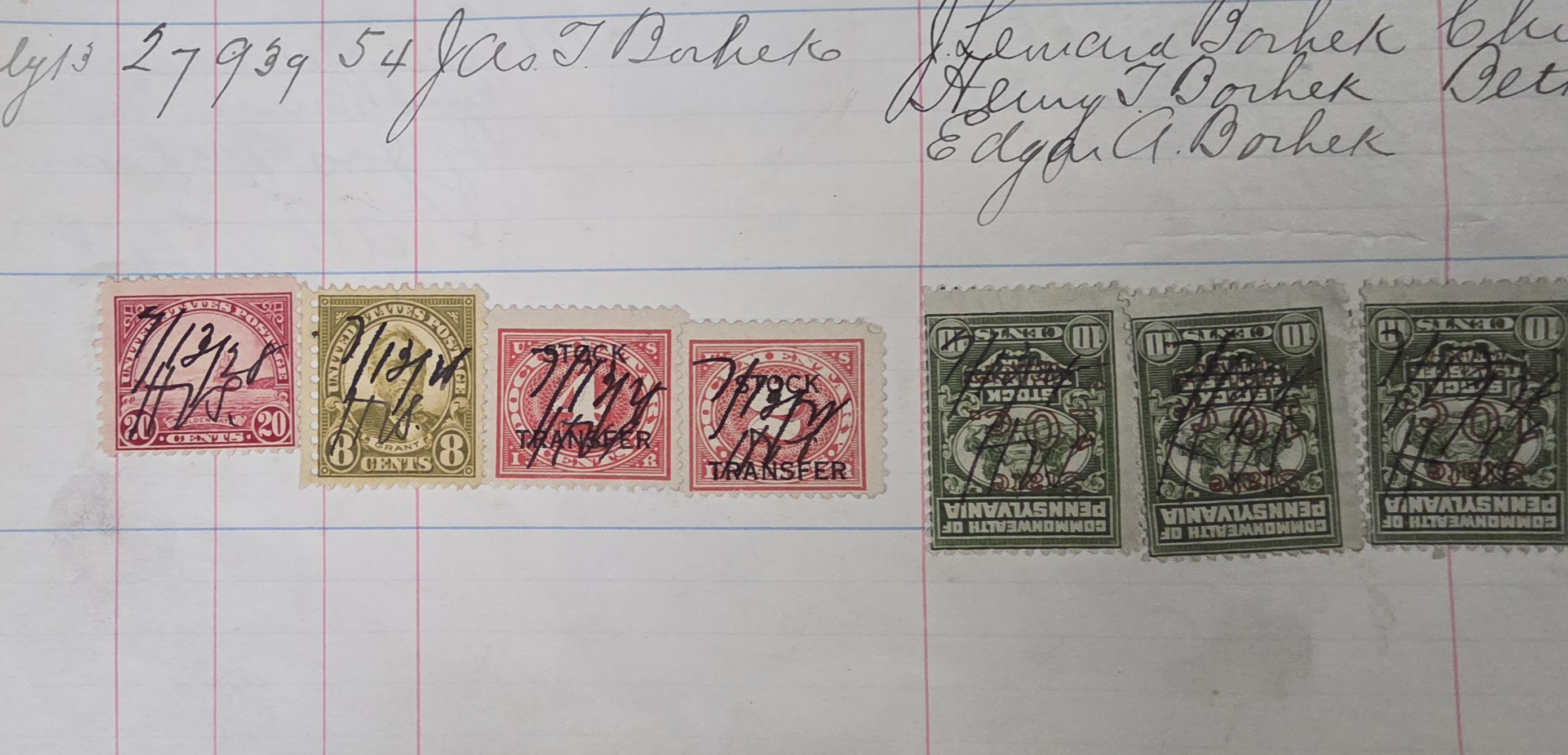
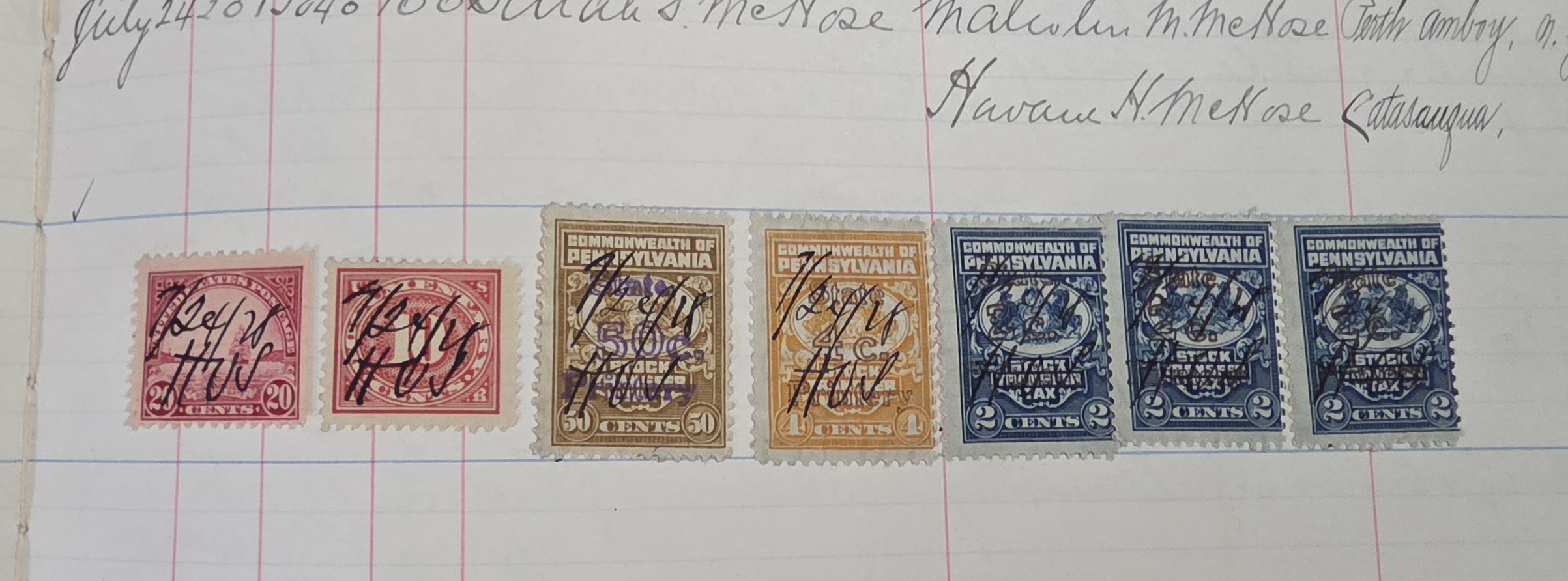
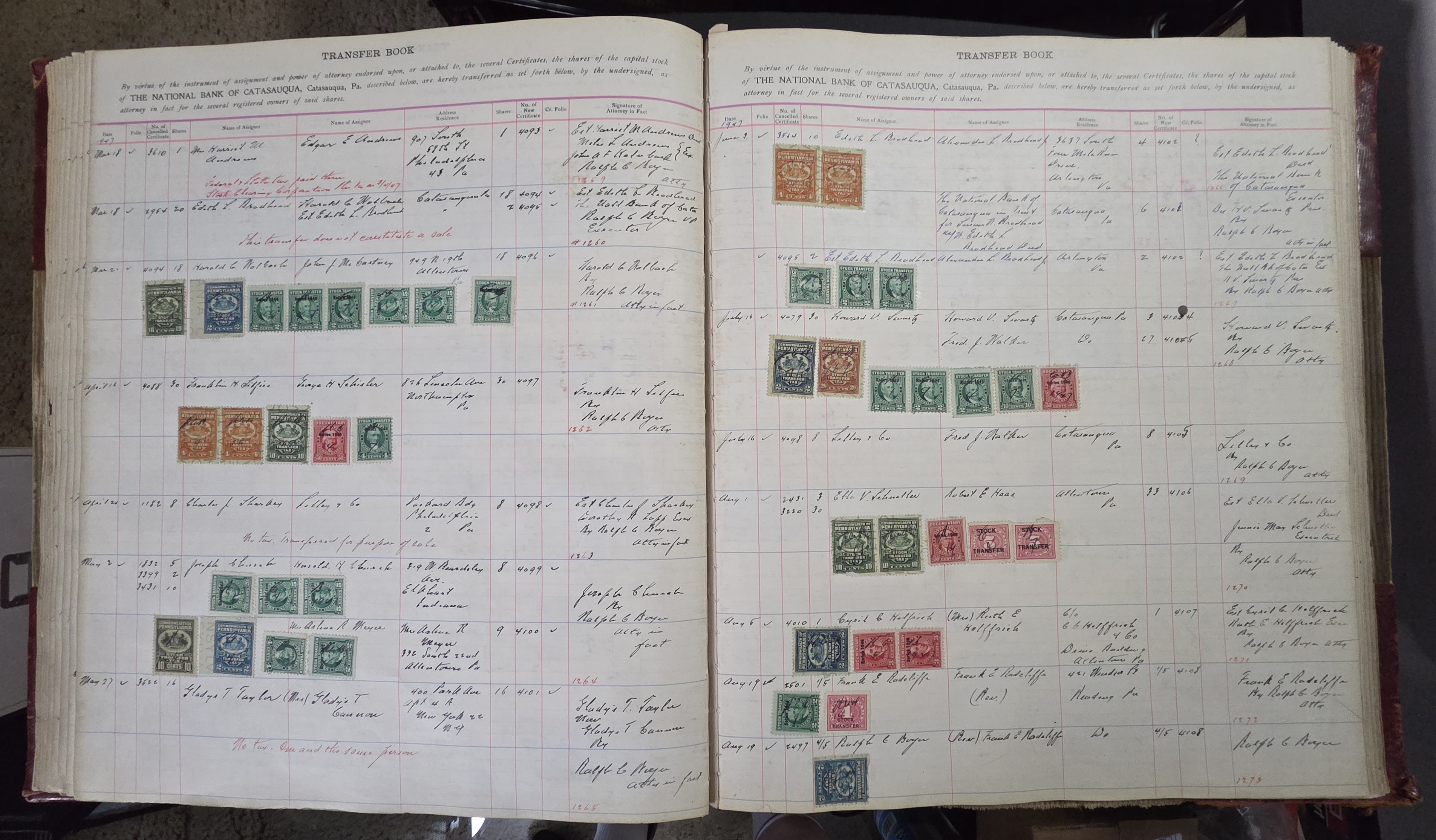
This two-page spread, which presumably nobody else saw as they were paging through the book. I showed it to Denny after I bought it, and he wasn’t even mad; he just said “Good eye!!”
It contains two line entries with postage stamps used improperly as revenue stamps, in fact stamps that I have not previously seen used as revenues: Scott #560 (8c Grant) and two of Scott #567 (20c Golden Gate Bridge). These two pages are welcome additions to my improper use collection!